When data came forward and change began
For 20 years, only limited data were published on the status of education in Bolivia. Without evidence, it was hard for civil society to push for change, even though what was happening on the ground pointed to serious problems. That started to shift in 2024, when the national education coalition, CBDE, decided that something had to move.
As a journalist, Jaqueline Vinoya has covered everything from the corridors of power to the most painful moments of the social conflicts that have brought grief to Bolivia. However, after years of reporting from the streets, she is convinced that the report “The State of Education in Bolivia”, produced by the Bolivian Campaign for the Right to Education (CBDE) in 2024, is the most significant piece of writing she’s contributed to.
“I remember thinking that this report is going this report is going to hit like a landslide. This would be the first time in 20 years that people would get to see the real picture of what was going on in our country, get to see how the education system has been failing our kids,” Jaqueline Vinoya said.
The ‘Status of Education in Bolivia’ report was published in August 2024 and is a collection of data on enrolment, retention, quality and learning outcomes in public primary and secondary schools – data that is systematically reported to the education authorities.
“But for many years, these data didn’t travel outside government offices — leaving the public in the dark, with only their own experience and hearsay to go on, too easy to dismiss when trying to hold anyone accountable,” added Jaqueline.
Getting the data out
As the national education coalition, CBDE is gathering civil society organisations and groups who works to improve the quality of the education system in Bolivia. For years, they had been asking for this crucial information on education to be made public, to allow civil society participation in education planning.
Eventually, after years of dead ends, they decided to produce the evidence themselves. “We gathered and analysed all the data on education and had it ready to present at major government-hosted education congress. But some didn’t want these findings out, so in the end, we weren’t invited,” said Cecilia Lazarte, director of CBDE.
“Instead, we occupied every entrance to the conference, handing out copies. That way, we made it onto the agenda anyway,” she added.
From data to debate
Pushed by the CBDE team, the report created exactly the level of attention and heated debate that Jaqueline Vinoya had envisioned. Newspaper articles, radio debates and TV interviews shared the findings: that alarmingly few students can read and solve maths problems to their expected level, that only 58 out of 100 complete school without interruption, that poor and rural children are disproportionately excluded, that curriculums are outdated, and that teachers are poorly trained and often left to teach without relevant materials.
That led to meetings, hearings and even demonstrations where civil society and the public demanded transparency, accountability and changes to the system.
“With this report, we were able to shine a light on the problems, and eventually that opened the door to authorities, who had been reluctant but recognised the need to work with civil society on solving the most pressing issues,” said Cecilia Lazarte.
More than 150,000 students are currently outside the Bolivian education system. We work to ensure that the human right to education becomes a reality for all of them – so that no one is left behind.
Cecilia Lazarte director, CBDE
There is a learning crisis in Bolivia. Over the past 20 years, quality has suffered, and especially the lack of reading has caused real harm, because reading and writing underpin all other subjects, including maths and science.
Patrizia Marín, education expert,
head of the association of private schools in Bolivia
The minister is pleased to have CBDE so involved and appreciates having the study and the Bank of Good Practices, as they give the best possible foundation for making good decisions.
Ademar Poma, Ministry of Education
The new government is more open to new ideas and is looking for sources of information that are reliable and non-political. CBDE produces materials developed by education experts, which fits well with that appetite.
Victor Hugo Villareal, Head of Knowledge Management, CBDE
Eventually, after years of dead ends, CBDE decided to produce the evidence themselves.
“We gathered and analysed all the data on education and had it ready to present at major government-hosted education congress. But some didn’t want these findings out, so in the end, we weren’t invited,” said Cecilia Lazarte, director of CBDE.
“Instead, we occupied every entrance to the conference, handing out copies. That way, we made it onto the agenda anyway,” she added.
Good ideas in the bank
And CBDE was ready to leverage the opportunity. From the outset, the strategy had been two-pronged — exposing the problem but also being a constructive partner able to propose ways forward. And for that purpose, CBDE had built a bank.
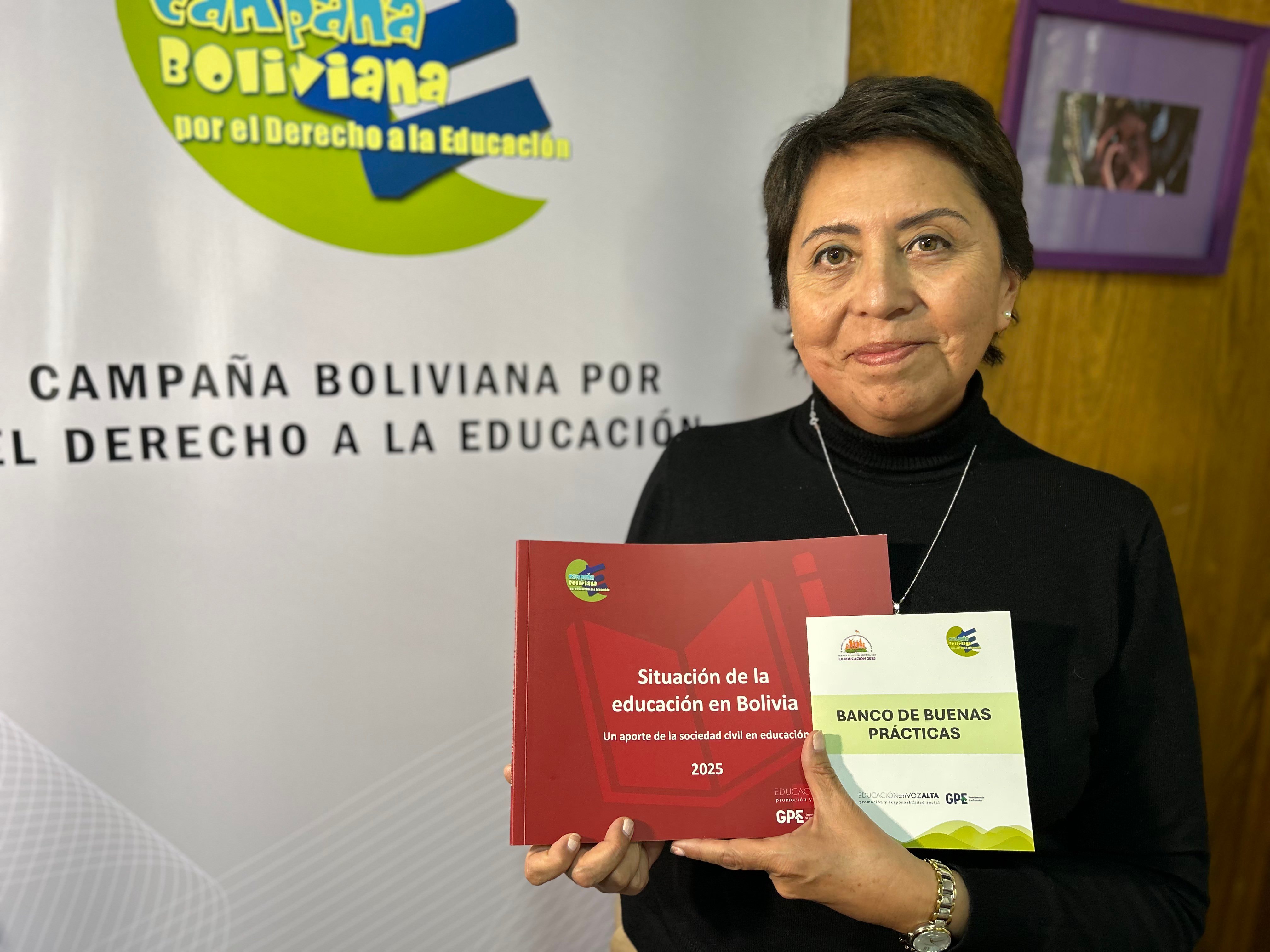
“A Bank of Good Practices,” explained Victor Hugo Villareal. He is an education expert and has been with CBDE since 2024 as Head of Knowledge Management. He is currently finalising the second edition of a wide-ranging collection of solutions and good practices from schools across Bolivia.”
“Institutions are largely left to themselves to find good ways of implementing the laws and policies, and many come up with solutions that work well. But they are rarely documented or shared, meaning that everyone has to reinvent the wheel, and authorities miss the chance to learn from what works and use it to build better policies and reforms,” said Victor Hugo Villareal.
The first edition contains 35 well-documented and easily replicable examples of methods or classroom practices that are working well, with a particular focus on inclusive education, multilingual and intercultural education, and education on emerging areas such as democracy or climate change.
“My personal favourite is from Cochabamba where students are combining theory with practice and has started both a tourism project and a local food production as part of their bachelor. And the examples on how to include emotional skills in education is also very valuable,” said Ademar Poma from the Ministry of Education.
What comes next
After nearly 20 years of continuous rule by the left-wing Movement for Socialism (MAS) party, a new government took office in Bolivia in November 2025, under President Rodrigo Paz Pereira. Education is a key priority for the new administration, and CBDE has already been invited to several meetings. Both the “State of Education in Bolivia” study and the “Bank of Good Practices” publication are now held at the minister’s office and serve as a point of reference for the new officials.
“The publications are well known and highly valued as they give the best possible foundation for making good decisions,” said Ademar Poma, confirming that it is a government ambition to increase the quality of education in Bolivia, and that they intend to work closely with think tanks, universities, and civil society to achieve that.
“This year’s new curriculum resolution already includes recommendations that came directly from CBDE. Our job now is to keep influencing key decisions and keep bringing experiences and good practices from the community level to the decision makers to ensure that the solutions match the reality on the ground,” said Cecilia Lazarte.