

New Publication: How civil society have used human rights law to advance the right to education
While education is widely recognised as a fundamental human right, many organisations face challenges in translating this legal recognition into effective advocacy. To help bridge this gap, the Right to Education Initiative (RTE) has launched How civil society organisations have used human rights law and mechanisms to advance the right to education: 5 case studies with inspiration and best practices.
This is an extract from a longer blog post. You can read the full post on RTE’s website.
Sidebar title
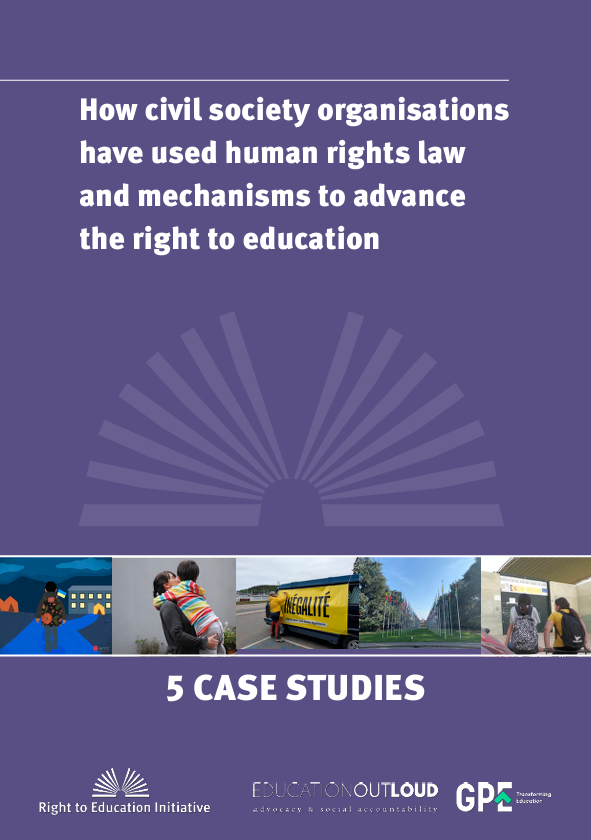
Publication: How civil society organisations have used human rights law and mechanisms to advance the right to education.
By Right to Education Initiative, a learning partner to Education Out Loud.
Human rights law provides the foundation for rights-based education advocacy. It establishes clear legal obligations for States and offers a range of mechanisms through which right holders can challenge violations and seek accountability. However, these mechanisms often remain underutilised by civil society organisations working in the education sector, mostly because they are unaware of their existence or because they do not know how to navigate the human rights system to harness meaningful and concrete change.
The publication How civil society organisations have used human rights law and mechanisms to advance the right to education: 5 case studies seeks to demystify human rights law and mechanisms by documenting real-life experiences of civil society organisations that have successfully incorporated them into their advocacy work. Through 5 practical case studies, the publication demonstrates how advocacy strategies can be anchored in human rights law and how different accountability mechanisms can be strategically mobilised to advance education rights. Each case study captures not only outcomes but also the strategic choices, challenges, and lessons that shaped the advocacy process, offering other organisations a roadmap they can adapt to their own contexts.
The publication was followed by a webinar where the various cases was discussed. Participants gained a deeper understanding of how human rights law can serve as a practical advocacy tool, increased familiarity with key human rights accountability mechanisms, and learned from insights from organisations that have successfully used these mechanisms in their advocacy efforts. Here are 10 main takeaways from the session.
- A human rights-based approach to advocacy is characterised by legal grounding, focus on states obligations according to the law, and accountability.
- Human rights accountability refers to the processes through which duty-bearers, mainly States, are held responsible for complying with their human rights obligations.
- Human rights accountability mechanisms strictu sensu refer to vertical, institutionalised, formal accountability procedures such as judicial and quasi-judicial accountability (courts, treaty bodies, special procedures). Social accountability and political accountability are enforced through public pressure, transparency, political dialogue and civic mobilisation.
- Social, political, judicial and quasi-judicial accountability are complementary and reinforce each other. Investing in long-term, multiple advocacy strategies increases the chances of success.
- Human rights mechanisms can be accessible, strategic, and effective avenues for civil society organisations seeking to advance the right to education, including in countries with restricted civic space where dialogue with the State is difficult or too sensitive.
- Many human rights mechanisms are not reserved for legal experts alone: civil society organisations of different sizes and capacities can use these mechanisms to influence decision-makers and advance systemic change, even if they have no prior legal knowledge.
- National human rights mechanisms like Ombudsperson and National Human Rights Commissions are usually very accessible to civil society organisations, and it is worth sustaining long term engagement with those institutions.
- Litigation can bring about systemic change, but may be a lengthy and costly endeavor that requires legal expertise and representation.
- International human rights mechanisms such as UN Treaty Bodies can be effective in pressuring governments to implement the right to education at national level. Civil society organisations do not need legal expertise to engage with UN Treaty Bodies but the UN system is not always easy to navigate, especially if you are reporting for the first time. Civil society organisations working on education issues can partner with local and international human rights organisations if they need help with the reporting or complaint procedure.
- Civil society organisations can start by mapping the national human rights institutions in their own countries and verifying the periodic review cycle in the UN Websites : UN Treaty Bodies and Human Rights Council Universal Periodic Review
Through the publication and continued peer sharing and learning, RTE and Education Out Loud hope to inspire more organisations to integrate human rights accountability into their advocacy strategies and strengthen efforts to ensure that every person can enjoy their right to education.