
Building belonging by integrating Ukrainian refugees into Moldovan schools
Building belonging by integrating Ukrainian refugees into Moldovan schools
Since the war began in 2022, thousands of Ukrainian refugee children have been welcomed into schools in neighbouring Moldova. The national education coalition has played a central role — supporting local member organisations in responding to the refugees’ needs and elevating their insights to shape the national response.
The Russian full-scale invasion of Ukraine was but a couple of hours old when the first refugees arrived in Căușeni in Moldova in February 2022. For months, the stone lions of the central square in the border town would every day witness the arrival of buses and cars with families escaping the danger and insecurity in their home country.
“When the refugees started to come, civil society and the community came together and did all we could to help the families – to help end their nightmare,” says Ana Schiopu, manager of the civil society organisation, Raza Încrederii (Ray of Hope). Raza Încrederii is a member of the national education coalition APSCF in Moldova, who is supported by Education Out Loud.
Like other APSCF members, Raza Încrederii responded to the emerging community needs. Their priority in Căușeni was to ensure the children’s sense of safety and to start paving the refugee children’s way back to school.
“What we could offer was extracurricular activities and tutoring to support the children’s well-being and academic development as they integrated into local schools, namely activities that would bring together Moldovan and Ukrainian children,” says Ana Schiopu of Raza Încrederii.
As a member of the national education coalition APSCF in Moldova, Raza Încrederii was able to access vital information from the secretariat on the situation and on government and civil society responses, as well as technical and financial support that proved crucial during those first intense weeks.
For its part, Raza Încrederii brought first-hand knowledge to the coalition about the needs emerging among the refugees and the host communities working to accommodate them.
Going to school made all the difference
One of the families who arrived in Căușeni in the early days of 2022 was Irina Odenobecova and her then nine-year-old son.
“We celebrated his birthday on 23 February, and the next morning, I got a call from my mother saying that the war had begun. We had to leave. My son was very scared, but people in Căușeni welcomed us with warmth and a lot of support,” says Irina.They hoped to return quickly, but the war continued in their home country. At first, Irina encouraged her son to follow online classes offered from Ukraine. But she soon felt that he needed the structure and social connection of everyday schooling.
“Looking back, going to school and making friends has made all the difference to my son. But it took time for him to thrive,” Irina says.
The turning point came outside the classroom, through activities like the ones organised by Raza Încrederii, that helped Irina’s son connect with local and other refugee children and made it easier for him to feel comfortable and start doing well in school.
In the beginning, the refugee children were scared and would often hide their faces and be jittery and tense, fearing Russian drones. Now they seem at peace, and able to socialise freely with others.
Ana SchiopuRaza Încrederii
My schoolmates welcomed me to the school, and they became friends. They invite me to play with them, and we do many activities together.
Renata, 10 years oldrefugee from Ukraine
I went to school two weeks after we arrived in Căușeni. It was important for me to go to school and study, but in the beginning, everything was unfamiliar. Then I met Zakhar (a new friend), and then I also started talking to others.
Vova, 9 years old Refugee from Ukraine
We are very thankful for the way we’ve been received in Căușeni. Thanks to the teachers and people here, my son and I are doing well.
Irina Odenobecova Ukrainian theatre and filmmaker,
mother of a 13-year-old son.
By combining policy advocacy, capacity building, community-based interventions, and direct support to educational institutions, APSCF and its members have helped create a more inclusive environment for refugee children in Moldova.
Irina PopusoiSecretary General, APSCF
From insight to policy
Experiences like these helped APSCF and its members identify broader challenges affecting refugee children’s education and wellbeing across Moldova. The importance of extracurricular activities and psychosocial support for families affected by the war was one of the insights that reached the national education coalition. Another was the fact that the widely used home-schooling was jeopardising the children’s wellbeing as isolation weighed on them, and as the worsening situation in Ukraine affected the quality of online teaching.
“We shared these insights, along with our recommendations, with the central education authorities, through the Refugee Education Working Group of UNHCR helping to inform the government’s response,” says Irina Popusoi, Secretary General, APSCF.
Through its advocacy and participation in national policy processes. APSCF contributed to the development of key policies and practical solutions aimed at ensuring access to education for refugee children. These included the Roadmap for the Inclusion of Refugee Children in the Education System of the Republic of Moldova, the Instruction on the Admission and Enrolment of Children from Ukrainian Refugee Families in General Education Institutions, including its subsequent 2024 amendments, and the official Procedure for the Enrolment of Children from Refugee Families from Ukraine. APSCF members also advocated for and supported the adoption of the Agreement between the Government of the Republic of Moldova and the Cabinet of Ministers of Ukraine on the Mutual Recognition of Education Documents and Scientific Degrees.
Through its participation in the Ministry of Education and Research’s Advisory Council on Inclusive Education, APSCF also promoted measures to ensure that refugee children with disabilities and special educational needs are not left behind.
“By combining policy advocacy, capacity building, community-based interventions, and direct support to educational institutions, APSCF and its members have helped create a more inclusive environment for refugee children in Moldova. These efforts ensure that Ukrainian children are seen not as temporary guests, but as valued and fully included members of their communities,” says Irina Popusoi.
“The food is nice and the teachers are kind”
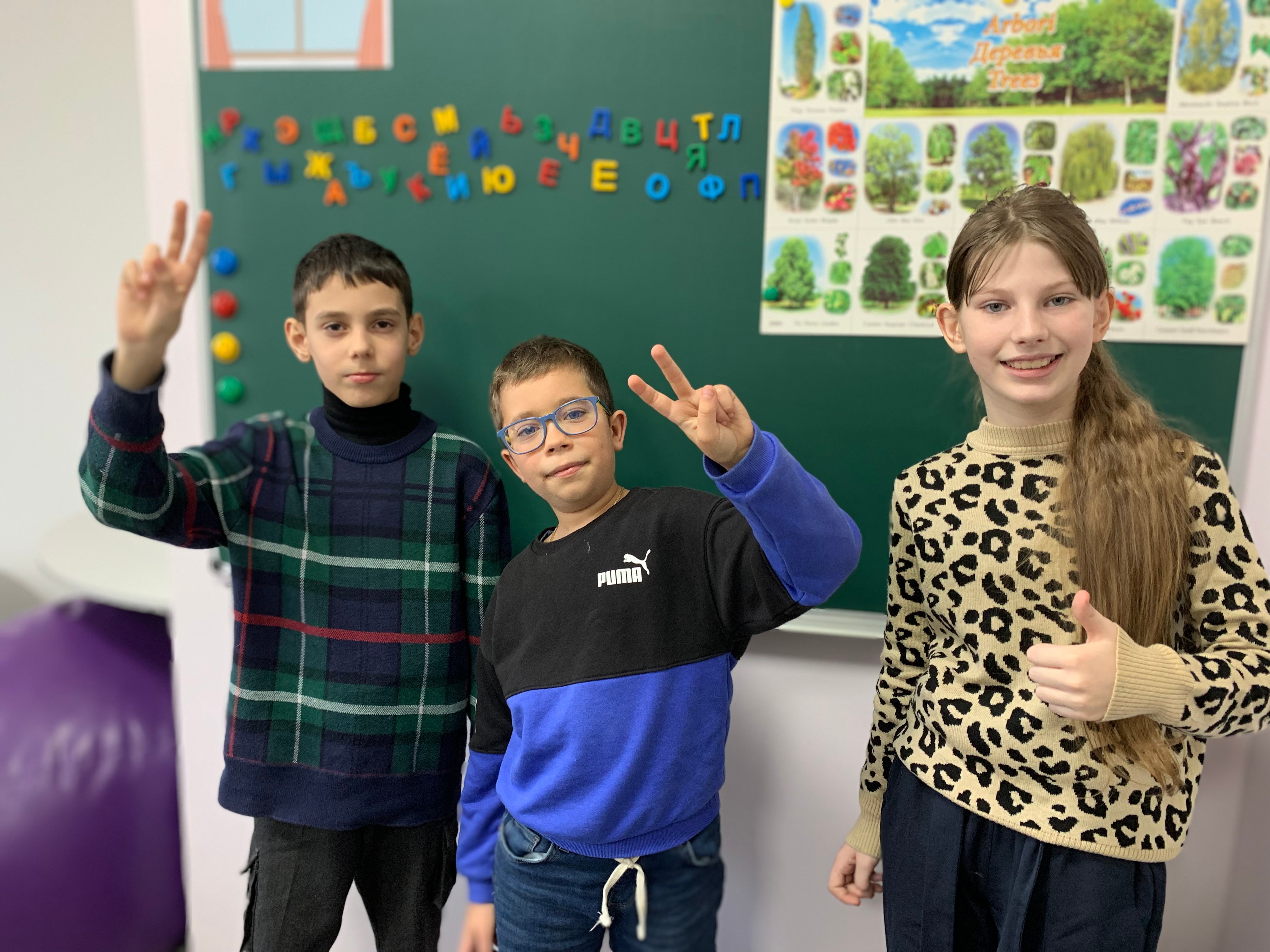
At one point, Alexandr Pushkin School in Căușeni had 300 Ukrainian students, including the son of Irina Odenobecova. With many refugees having returned or travelled onward, the current number is 83. Among them are Renata, Vova and Maxim, aged 9 and 10.
“I like being in school. People are friendly and everyone is welcome even if you have problems or health issues. Everyone can be helped here,” says Vova, who is in class 4 and came to Căușeni two years ago.
They feel that they have benefited from the school’s inclusive approach, which has allowed them to integrate at their own pace. Today, they often go several hours a day without thinking of themselves as refugees or as different from their peers. Renata, who is in class 5, adds:
“I don’t miss my home in Ukraine very much. It is only my grandmother who lives there now. I would like to go there on a visit, but Moldova feels like home now.”
As the acute refugee crisis has evolved into a more long-term situation, and everyday life has settled for both hosts and newcomers in towns like Căușeni, the lessons learned from supporting refugee children’s inclusion have shaped APSCF’s broader advocacy agenda.
Their advocacy is no longer centred specifically on refugee integration, but more broadly on inclusive education — promoting a school system with support teachers, close cooperation with parents and the local community, and space for every child and their unique strengths and challenges. “Refugee children are already part of our communities. Our responsibility is to ensure that every child has access to the support, opportunities, and services they need to thrive and reach their full potential,” says Irina Popusoi.