

How to Make Your Seat at the Table Count
Drawing on a new Education Out Loud–commissioned qualitative study by independent learning and evaluation consultant Abrehet Gebremedhin, this article shares learning from grantees and other stakeholders’ perspectives on meaningful participation in policy forums.
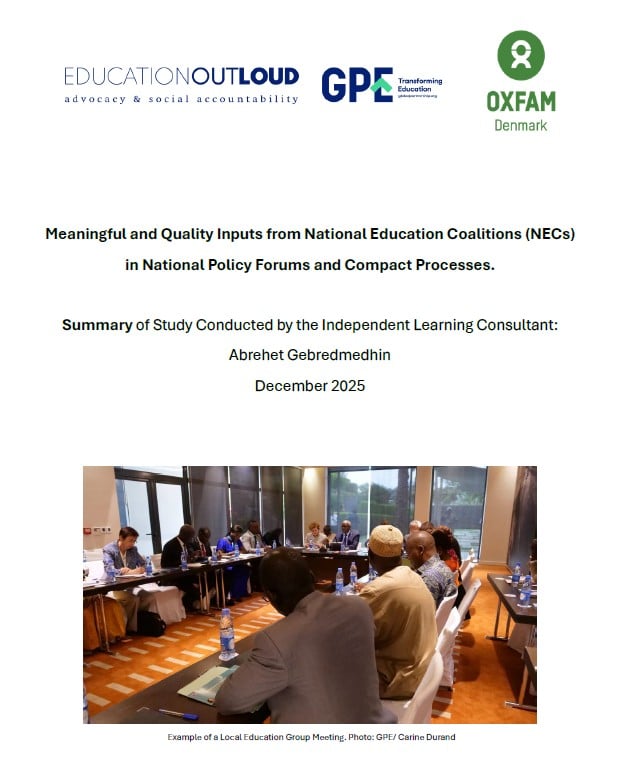
Across the world, representatives from civil society take their seats alongside governments and development partners at tables where education priorities are debated, budgets discussed and national plans shaped. By 2025, 93 per cent of Education Out Loud–supported national education coalitions (NECs) were members of their national Local Education Group, and many were active across other multiple policy spaces.
While access to policy forums has expanded for many NECs, the study shows that participation alone does not determine influence; what matters is how participation is prepared, enacted, and enabled within specific institutional and political contexts.
“Coalitions are increasingly recognised as legitimate actors in education policy dialogue. While gaining access to policy forums has been an important and celebrated milestone for Education Out Loud, presence alone does not guarantee influence,” says Abrehet Gebremedhin, independent researcher and learning partner to Education Out Loud.
“That is why Education Out Loud asked me to carry out a study drawing together experiences and insights from national education coalitions and stakeholders who interact with NECs at a country level on what enables meaningful participation,” she adds.
The learning presented here is grounded in NECs’ own reflections on meaningful participation, complemented by perspectives from other national education stakeholders to provide context and triangulation.
What civil society advocates gain from participation
The study first establishes that participation in policy forums is a priority for NECs, and that increasing the outcomes of this presence would be a clear benefit.
“The coalitions point to improved access to decision-makers, and report that participation pushes them to sharpen their strategic focus, improve their use of evidence, and strengthen coordination with members. Finally, many coalitions report stronger advocacy outcomes,” says Abrehet Gebremedhin.
Drawing on coalitions’ reflections, five common themes emerge around how coalitions approach participation, balance different demands, and use the space they are given in ways they experience as meaningful. These trends reflect learning from practice that may offer inspiration to others seeking to make participation count.
Five trends in NECs’ experiences of meaningful participation
- It is important to ground participation in evidence
Across the study, grantees consistently describe meaningful participation as being closely linked to the use of evidence, analysis and community-level insights that resonate with decision-makers. Many point to the value of drawing on data gathered through coalition members and sub-national networks to bring grassroots realities into national policy spaces. Grantees also highlight the role of alternative or shadow reports, based on local monitoring and participatory research, as a way of substantiating their contributions in Local Education Groups and other forums. - Internal coordination and a shared voice strengthen coalitions’ credibility
Grantees frequently describe meaningful participation as beginning within the coalition itself. Many point to the importance of consulting members in advance of policy meetings, aligning positions, and speaking with a collective voice that reflects diverse civil society perspectives. These internal processes are seen as strengthening both legitimacy and credibility in the eyes of other stakeholders. Grantees note that when coalitions are perceived as genuinely representative, their contributions are more likely to be listened to and taken seriously in policy dialogue spaces. - Strategic and tactically aware engagement helps participation move beyond presence
Grantees reflect on the need to navigate policy spaces with political and tactical awareness, balancing critical advocacy with constructive engagement, particularly in settings where civic space is constrained or relationships with government are sensitive. Bringing solutions, framing messages carefully, and choosing when and how to engage are all described as ways of maintaining space for dialogue. - Understanding how decisions are made supports more meaningful participation
Familiarity with how forums operate, when decisions are taken, and which actors hold influence is described as helping coalitions time their inputs and tailor their contributions. Rather than focusing only on technical content, grantees emphasise learning how policy processes function in practice, and how this knowledge supports participation that is better targeted and more likely to be heard. - Political and civic contexts shape what meaningful participation looks like in practice
Finally, grantees underline that experiences of meaningful participation vary significantly depending on political context and civic space. In more open environments, coalitions describe having greater room to engage actively and visibly in formal policy forums. In more restrictive settings, participation may take different forms, including bilateral engagement or alternative spaces for influence. These reflections point to the importance of understanding meaningful participation as context-specific, shaped as much by external conditions as by coalition capacity.
Interviewees emphasized that these approaches do not operate uniformly across contexts, and that their effectiveness depends on factors such as civic space, institutional openness, and the responsiveness of other actors in the policy process.
Grantees’ experiences highlight that being in the room matters, but influence depends on how that presence is used—through evidence, collective positioning, and an understanding of context. The study also suggests that meaningful participation is co‑created: shaped by both civil society capacity and the institutional and political conditions that allow participation to move beyond presence to substance.
“My hope is that this learning can encourage others to reflect on their own engagement and find ways to make participation count in the spaces available to them,” concludes Abrehet Gebremedhin.
For a fuller analysis of how meaningful participation and quality inputs are understood by both NECs and policy actors, see the summary report.