
french translation of: How civil society uses digital tools to strengthen accountability in education
A new publication from Education Out Loud learning partner IIEP-UNESCO explores how civil society organizations use digital technologies to promote transparency.
Publication:
Digital tools for transparency and accountability in education
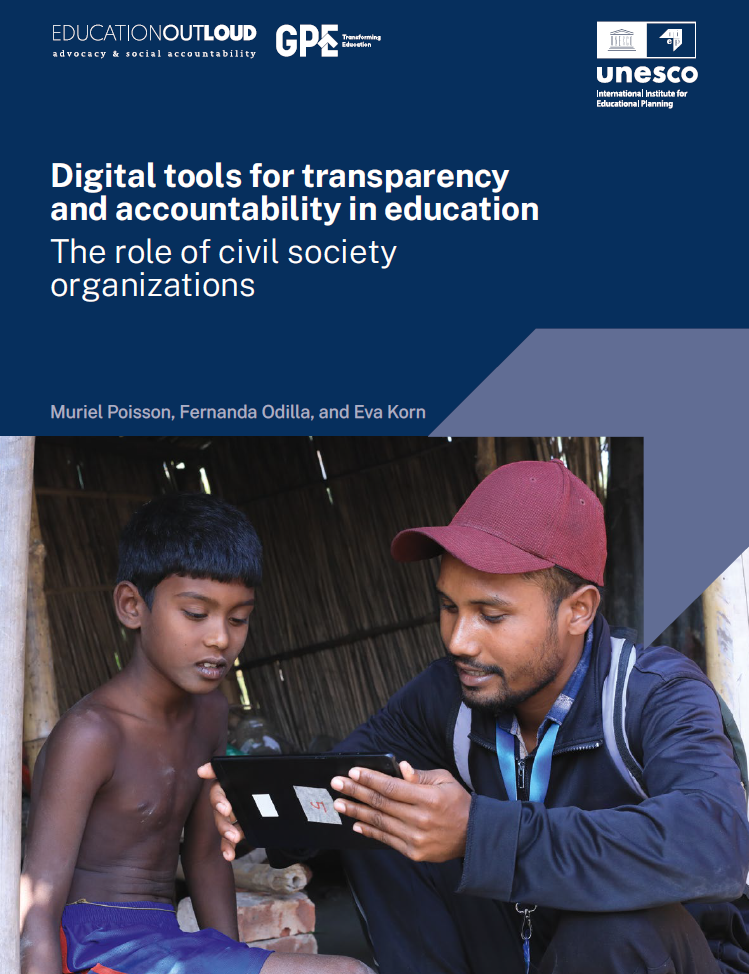
Download the report or read more on IIEP Unesco website.
From data portals, artificial intelligence, and monitoring platforms to social media campaigns, civil society organizations (CSOs) use many kinds of digital tools to strengthen transparency and accountability in education. They can help citizens scrutinize government spending and identify gaps in education service delivery. But how effectively do digital tools turn access to information into meaningful change?
A new publication by the UNESCO International Institute for Educational Planning (IIEP), developed as a Global Learning Partner in the Education Out Loud initiative, funded by the Global Partnership for Education (GPE), explores this question in depth.
Digital tools for transparency and accountability in education: The role of civil society organizations, by Muriel Poisson, Fernanda Odilla, and Eva Korn, combines a literature review of some 70 sources, a survey of organizations across 23 countries, and seven case studies of initiatives led by CSOs.
The findings show that digital tools can strengthen education governance by making information more accessible, supporting citizen monitoring, and informing advocacy. Yet examples worldwide show that effectiveness depends on reliable data, sustained funding, technical capacity, and public authorities’ willingness to respond.
Turning digital opportunities into lasting accountability
The publication examines initiatives in Benin, Mozambique, The Gambia, South Africa, Pakistan, and two in Nigeria. Together, the seven case studies show how CSOs use digital tools to address issues such as resource mismanagement, insufficient funding, and lack of transparency.
Case: The Data Portal by
the Pakistan Coalition for Education
Launched in 2020 by the Pakistan Coalition for Education (PCE) the Data Portal was created in response to the challenge of accessing consolidated, understandable education data.
The Data Portal shows how civil society can use digital tools to make education data and information more accessible and support evidence-based advocacy.
 More about the portal
and Q/A with the Pakistan Coalition for Education
The publication also draws on a survey of 50 organizations across 23 countries. More than 80 percent of respondents identified improving access to information as a priority, while 62 percent wanted to strengthen engagement with their target groups. Nearly four in five used ICT tools to analyse corruption, and 63 percent used them to help prevent it.
ICTs hold promise for improving transparency and combating corruption in education.However, realising this potential requires stronger evidence, sustained investment, ethical safeguards, and closer collaboration between civil society and public authorities.
The publication provides the following recommendations for CSOs:
- Adopt standardized digital platforms across sectors,
- Prioritize outreach initiatives to ensure representation,
- Ensure robust data protection,
- Invest in capacity building,
- Plan for sustainability,
- Prioritize monitoring and evaluation,
- Include ICTs as part of wider anti-corruption strategies,
- Integrate citizen feedback mechanisms,
- Foster partnerships with government, CSOs, and international organizations.
For education authorities, the publication also provides the following recommendations:
- Promote multi-stakeholder partnerships.
- Establish appropriate legal frameworks,
- Embed participatory practices into policy frameworks,
- Improve access to education data and information.
Read more and access the full report on the IIEP Unesco webpage