
french translation of the headline
In a country fractured by conflict, displacement, and an imminent economic collapse, the Yemeni Coalition for Education for All (YCEA) has achieved something remarkable: it has helped shape a unified national education strategy for Yemen.
“We consider it a milestone. It is the first unified national education vision within the conflicting situation. And it is developed through an inclusive dialogue where the voices of underrepresented groups were also heard,” said Abdulqawi Saif, National Coordinator of YCEA, who calls the plan “a beacon of hope” in an extraordinarily challenging context.
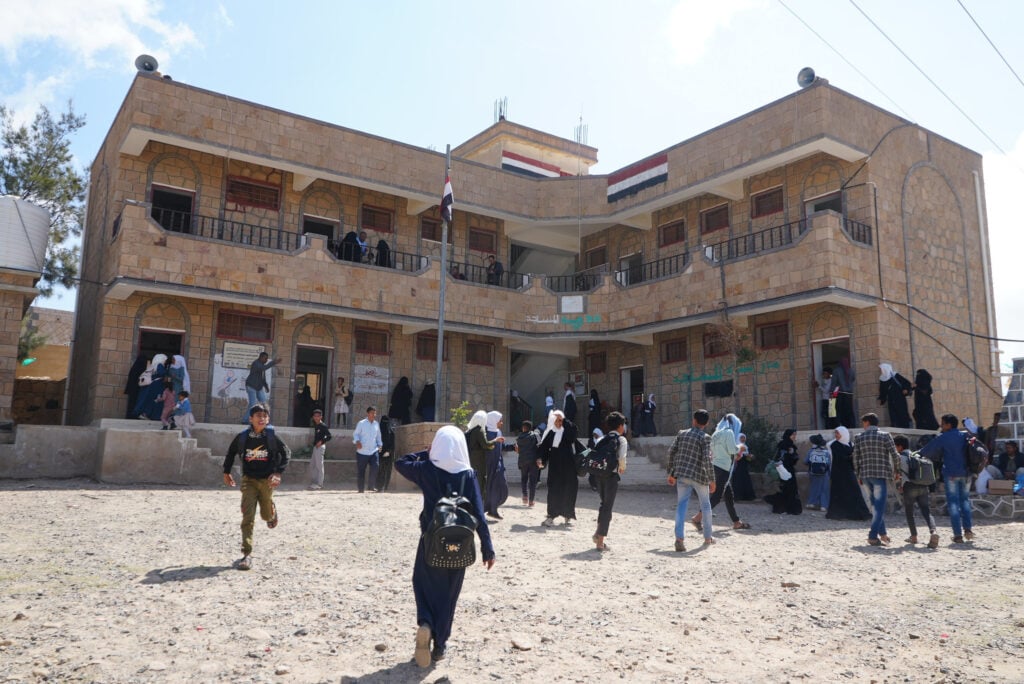
Photo: Anas Hassan Ahmed Ahmed Al Haj / AP Images for GPE
The Education Sector Plan 2024–2030 is a comprehensive national policy framework that sets out Yemen’s goals for rebuilding and transforming its education system. The plan focuses on access, quality, early childhood development, governance, and alternative education, and embeds gender equality and social inclusion across all goals, addressing the specific needs of girls, children with disabilities, and marginalised communities.
Supported by Education Out Loud, YCEA influenced the policy by participating in key policy discussions and consultations, reviewing and analysing policy drafts, submitting evidence-based recommendations, and ensuring the inclusion of underrepresented groups’ perspectives.
“It is a strategic roadmap to restore, strengthen, and transform Yemen’s education system, and we are proud of our role in ensuring that it reflects the needs of vulnerable populations while reinforcing civil society’s voice,” said Abdulqawi Saif.
A strategy of neutrality
YCEA was founded in 2012 as a non-political coalition of civil society organisations, unions, and marginalised groups advocating for education in Yemen. Just three years later, war broke out, and the coalition found itself operating in a country where over 11 million children — one-third of the population — were affected by conflict.
“The conflict has deprived millions of children of education. Close to 3,000 schools have been destroyed or used for other purposes, and no new ones have been built. Teachers go without salaries; entire communities are displaced, and the functioning schools are overcrowded,” said Abdulqawi Saif, whose own coalition has felt the effect of the country being torn apart. The coalition’s membership has plummeted from 195 to just 35, as many organisations were shut down by authorities over alleged ties to rival factions, while others collapsed under financial strain, security threats, or staff displacement.
Despite these challenges, YCEA continued to work with communities and authorities, advocating for temporary classrooms, training volunteer teachers, and the inclusion of IDPs, girls, and children with disabilities, as these groups were hit hardest by the conflict. A notable achievement, according to Abdulqawi Saif, is that YCEA has been able to operate across both sides of the conflict, collaborating with both the internationally recognised government based in Aden and the Supreme Political Council, informally known as the Houthi government, which governs Sana’a and northern Yemen.
“We adopted a strategy of neutrality, and although we’ve recently had to scale down activities in the north, our continued presence there — working with communities and authorities — has been crucial. It enabled us to influence the education sector plan so that it is a unified national strategy,” said Abdulqawi Saif. “The plan envisions a future of peace and unity. It really stands for us as a beacon of hope.”
Regional learning parnters
- The Yemen Education Sector Strategic Plan (ESP) 2024–2030 is a comprehensive national policy framework aimed at rebuilding and transforming Yemen’s education system.
- The ESP replaces the Temporary Education Plan with a more ambitious, long-term strategic framework aligned with national development goals and the 2030 Agenda for Sustainable Development.
The plan focuses on: Access to Education, Quality of Education, Early Childhood Development (ECD),
Governance, Literacy and Alternative Education - The ESP introduces a shift towards evidence-based, participatory, and results-focused planning, informed by consultations with a wide range of partners and based on a formal education sector analysis. It also strengthens systems for monitoring, evaluation, and policy execution, aiming to improve decision-making and resource allocation.
- The ESP is now endorsed by the full community of development partners, including UN agencies, donors, and NGOs.
- The Yemeni Coalition for Education for All, supported by Education Out Loud, influenced the policy change by actively engaging at multiple stages of the policy development process. YCEA participated in key policy discussions and consultations, reviewed and analysed policy drafts, submitted evidence-based recommendations, and ensured the inclusion of underrepresented groups’ perspectives.
- Additionally, YCEA advocated and negotiated policy provisions that promote inclusivity and equity in education. According to YCEA, this combined approach ensured that the final policy reflected the needs of vulnerable populations and strengthened civil society’s role in education governance.