
french translation of: How Civil Society Helped Turn National Education Commitments into Local Action
In Barahatal Rural Municipality in Nepal, education planning is no longer guided by fragmented decisions or disconnected programmes. For the first time, a ten-year Local Level Education Plan (LLEP) – developed collaboratively by local government, communities and civil society, is providing a single framework to guide education priorities, budgeting and accountability.
Located approximately 30 kilometres from the administrative capital of Karnali Province in Nepal, Barahatal faces a combination of geographic, economic, and environmental challenges that make education planning particularly difficult. Ms. Dambari Rokaya, Head of the Education Department, Barahatal Rural Municipality, explained;
“Scattered settlements, rugged terrain, seasonal migrations of families and recurrent natural disasters disrupt regular attendance and have led to limited access to school.”
These barriers often intersect with poverty, gender norms, care responsibilities, and inaccessible infrastructure, increasing the risk of exclusion for the most vulnerable children.
Under Nepal’s federal system, local governments are expected to adapt national education priorities to their own context through Local Level Education Plans (LLEPs). To help local governments develop these plans, the Center for Education and Human Resource Development (CEHRD) under the Ministry of Education and Sports has been conducting nationwide workshops and providing technical guidance.
From Barahatal, Ms. Dambari Rokaya participated in a three-day workshop organised by CEHRD in Kathmandu. She was among the participants nominated by SAC Nepal, a member organisation of the National Campaign for Education (NCE) Nepal, in response to CEHRD’s call for representatives from Karnali Province. However, translating that training into a locally grounded plan proved difficult, as elected representatives were unclear about the value and purpose of the plan. As noted by Mr. Tej Sonam, Coordinator, Surkhet District Committee, NCE Nepal, “’Why should we prepare this plan? What will happen after it is developed?’ were among the questions local officials were asking.” NCE Nepal and its members stepped in to bridge that gap through dialogues and sensitisation with the local government on the importance of having a long-term education roadmap.
Through continued facilitation, technical support and coordination with stakeholders, the process moved forward leading to the approval of Barahatal’s 10-year Local Level Education Plan in May 2025, providing the municipality with a long-term framework to guide education planning, budgeting and accountability.
From Advocacy to Action: Shaping the LLEP
Following the workshop by CEHRD, NCE Nepal and its members stepped in to support the process. Acting as a bridge between communities and government, the coalition helped municipal leaders understand the value of long-term education planning while bringing the perspectives of teachers, parents, girls, children with disabilities and marginalised communities into the planning process.
Barahatal required a structured approach to ensure that education activities across the municipality were guided by a shared long-term framework. NCE Nepal supported the development of the LLEP by strengthening local understanding and ownership of the planning process, providing technical support, facilitating stakeholder dialogue and maintaining coordination throughout the process.
NCE Nepal also drew on a booklet they developed for ‘Localization of School Education Sector Plan (SESP)’, a rights-based resource that clarified the roles of different levels of government and civil society in education planning, emphasised why localisation matters, and outlined how communities could engage in accountability and advocacy. This complemented the government’s SESP Calibration Toolkit developed by CEHRD, which provided local governments with step-by-step guidance on leading the planning process.
Beginning in January 2025, the process unfolded in four phases:
Phase 1:
Orientation and Taskforce Formation
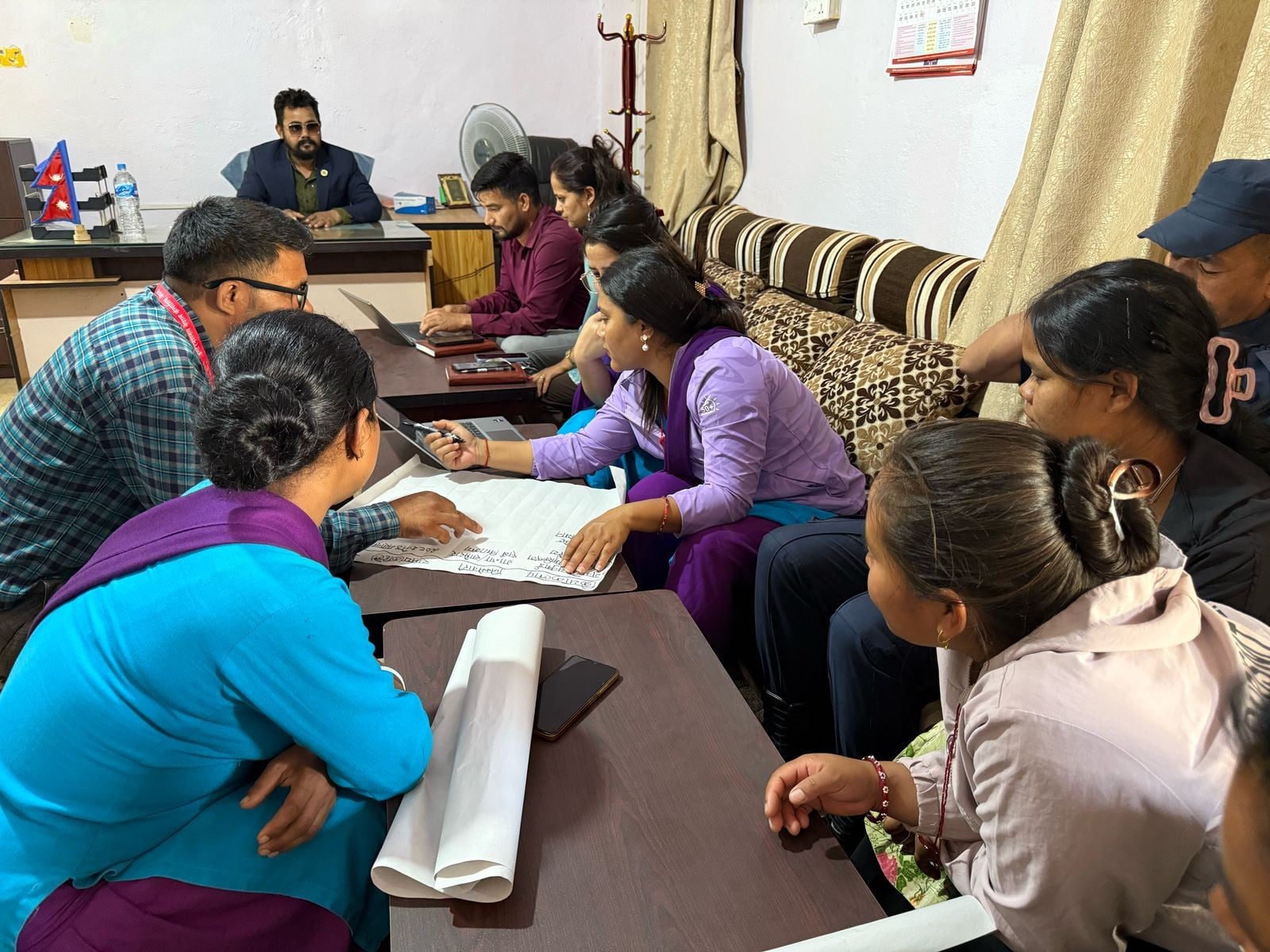
During the first phase, the Head of the Education Department, Ms. Dambari Rokaya, and NCE Nepal members worked closely to orient the rural municipality representatives and other officials on the toolkit, framework and the plan’s significance. The orientation led to the formation of thematic taskforces, such as for Early Childhood Development, Basic Education, Higher Education, Informal Education and so on, which led to the drafting of respective parts of the plan. The thematic taskforces brought together teachers, parents and marginalised communities.
A Gender Equality and Social Inclusion (GESI) analysis identified girls, children with disabilities and Dalit children as most at risk of dropout. The findings helped inform the priorities in the LLEP, while NCE facilitated the activation of the Girls and Inclusive Education Network (GIEN) to strengthen the participation of groups whose perspectives could otherwise be overlooked.Peer organizations, organizational development practitioners, research institutions or consultants that support learning among grantees.
Phase 2: Capacity Building and Planning Workshops
Each thematic taskforce participated in a two-day workshop to learn how to develop their sections, follow the required framework and apply the CEHRD SESP Calibration Toolkit to ensure that the plan remained aligned with the national standards while meeting the local priorities.Proven experience in relevant thematic, advocacy or organizational areas of learning. Grounding in the global south and knowledge of grantees’ context.
Phase 3: Drafting
After the taskforces produced their respective sections, a compilation team, led by the Head of the Education Department, brought these together to form a consolidated draft of the LLEP.Legitimacy – shared values, rights-based approach to civil society participation and education. Experience and methodological capacity in facilitating learning processes in organizations. Capacity to work with a gender transformative approach. Ability to engage grantees in action research or collate experience across the EOL portfolio.
Phase 4: Review, Feedback and Approval
CEHRD and development partners organised a five-day Education Policy and Guidelines Orientation in Karnali, where Barahatal’s draft local plan was presented. Feedback on GESI and non-formal education was incorporated into the plan. A Technical Advisory Committee was then formed to review the revised draft before it was submitted to the Executive Committee for approval. Barahatal’s 10-year Local Level Education Plan was formally approved in May 2025.
“NCE Nepal and its members’ technical support, constant follow-up, and facilitation of stakeholder dialogue were critical to the plan’s approval,” noted Ms. Dambari Rokaya.
What Has Changed?
With the approval of the LLEP, education planning, budgeting, and school-level priorities in Barahatal are now guided through a common long-term framework. The plan provides a basis for the municipality to coordinate education programmes, prioritise resources based on community needs, and connect School Improvement Plans with municipal planning and budgeting.
“If implemented effectively, the plan is expected to help reduce student dropout and strengthen continuity of education for vulnerable learners. It will also reduce the need for students to travel to Birendranagar for tuition. And the planned provision of a residential school may also help children from families who migrate seasonally for work remain in school and continue their education,” said Mr. Tej Sonam.
And Ms. Dambari Rokaya added: “I believe that with this plan and NCE Nepal and its members’ support we will be better positioned to address existing challenges related to student dropout through parenting education and successful implementation of planned programmes in Barahatal.”
Why This Matters
Barahatal’s experience shows how civil society and government can work together to translate national education commitments into locally owned actions. CEHRD provided technical framework and guidance, while NCE members helped local stakeholders understand, apply and strengthen the planning process, while also bringing diverse voices of girls, parents, children with disabilities and marginalised groups.
The significance of the Local Level Education Plan is not simply that a document was produced. It is that the municipality now has a shared roadmap for education decision-making that connects school priorities, community needs and public resources within a single structure. “It has introduced a more coordinated approach to education decision-making, while also creating a shared framework to track overall progress,” said Mr. Tej Sonam from NCE Nepal.
The process also helped make education planning more inclusive, evidence-informed and responsive to local realities. Through collaboration between local government and civil society, community perspectives became an integral part of education decision-making rather than a one-time consultation exercise.
The true test will come through implementation. But Barahatal now has something it lacked before: a locally owned plan, developed through dialogue and participation, that can help ensure national commitments to education are translated into better opportunities for children in the community.